

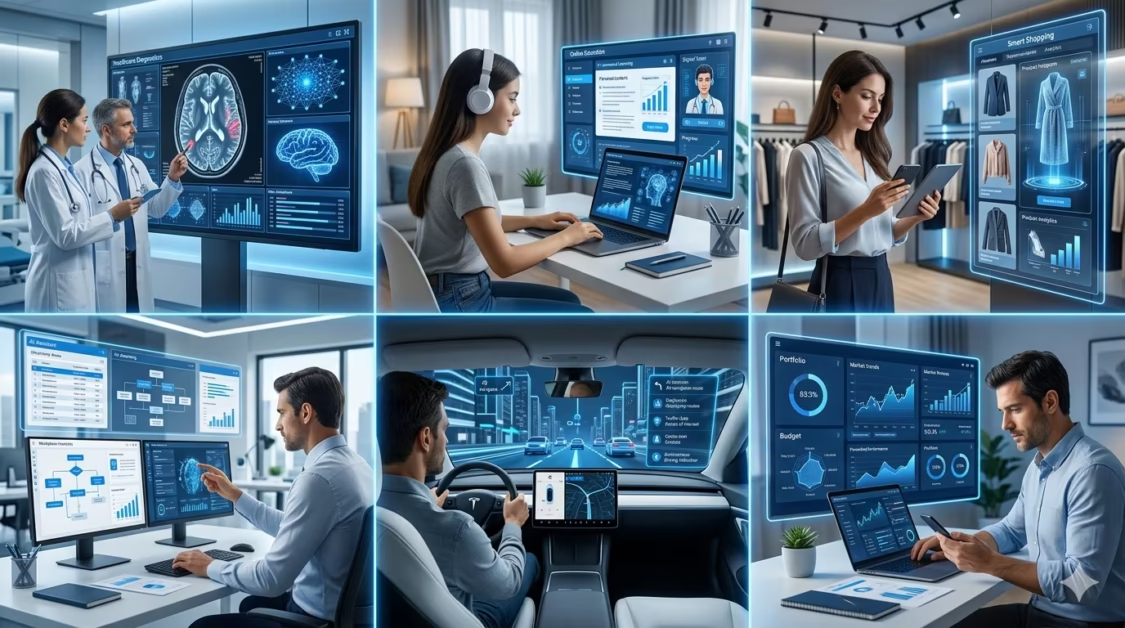
Technology has become the quiet engine running behind almost everything we do — from the alarm on your smartphone to the fraud detection protecting your bank account while you sleep. Yet most conversations about these breakthroughs stay buried under jargon, white papers, and developer documentation that leaves ordinary people feeling locked out.
This article cuts through the noise. Rather than explaining algorithms or code, we are zeroing in on the real-world use cases of AI technology that everyday people already experience. Whether you are a student, a small business owner, a busy parent, or simply someone who wants to get more out of the tools already in your hands, understanding these real-world use cases can shift how you see — and use — the world around you.
No developer talk. No acronym soup. Just what matters.
Table of Contents
Real-World Use Cases: What They Are and Why They Matter

Before diving in, it helps to get one thing clear. Real-world use cases are specific applications of technology — especially artificial intelligence — that address genuine human problems in real environments. These are not simulations. They are not proof-of-concept demos stuck inside a lab. They are live systems that millions of people rely on every single day, often without realising it.
Understanding real-world use cases puts you in a stronger position as a consumer, an employee, and a citizen. The most powerful real-world use cases tend not to be the dramatic, cinematic kind — no sentient robots or world-domination plotlines. They are the quiet, invisible kind: the systems optimising your commute, the tools personalising your child’s learning, and the algorithms flagging a suspicious charge on your card before you even notice it.
Real-World Use Cases in Healthcare: Technology That Is Saving Lives

Healthcare is one of the most emotionally significant arenas where applied technology is making a concrete difference. The real-world use cases here span early disease detection, mental health support, drug discovery, and surgical assistance — and they are already influencing patient outcomes around the world.
AI-Assisted Diagnostics
One of the most widely documented real-world use cases in medicine is AI-powered diagnostics. Google DeepMind has demonstrated that AI can detect over 50 eye diseases from retinal scans with accuracy matching specialist ophthalmologists. In radiology departments across the United States and the United Kingdom, AI tools are already analysing medical imaging faster than any human team — helping catch cancers and cardiovascular conditions at earlier, more treatable stages.
Mental Health Support Between Clinical Sessions
Among the most personal real-world use cases of modern technology is digital mental health support. Apps like Woebot and Wysa use evidence-based AI conversation frameworks to offer cognitive behavioural exercises and emotional check-ins between therapy appointments. These tools are not replacements for human clinicians — but they meaningfully extend access to support for people who might otherwise go without it entirely.
These real-world use cases in healthcare share a common thread: technology at its best removes the barriers between people and the help they genuinely need.
Real-World Use Cases in Education: Learning That Adapts to You

Traditional education follows a rigid structure — one pace, one curriculum, one standard for an entire classroom. AI is changing that. The real-world use cases of AI in education are among the most democratising developments of the past decade, expanding access to quality learning across income levels, geographies, and languages.
Personalised Learning Platforms
The clearest real-world use cases of adaptive technology in education come from platforms like Khan Academy and Duolingo. These tools do not simply deliver pre-packaged content — they actively track each learner’s weaknesses, adjust difficulty in real time, and present concepts in the format that suits that individual best. The result is something that was impossible to deliver at scale even ten years ago: a genuinely personalised education for every learner.
Language Learning Without a Classroom
Perhaps the most universally embraced real-world use cases of modern technology are language learning apps. Duolingo alone serves over 500 million users with AI-driven, gamified lessons that adapt to each person’s performance in real time. Tools like Google Translate and DeepL have reduced language barriers so dramatically that real-time cross-language communication — once the realm of science fiction — is now a daily reality.
These real-world use cases are particularly significant because they level the playing field regardless of geography. A student in rural Punjab has access to the same adaptive learning tools as a student at Oxford or MIT.
Real-World Use Cases in Retail and E-Commerce: Technology That Knows What You Want

You do not need to study consumer behaviour to notice how well modern retail seems to understand you. The real-world use cases in online and in-store shopping have made buying faster, more personalised, and — arguably — more addictive.
Recommendation Engines That Actually Work
The recommendation algorithms powering Amazon, Netflix, and Spotify are among the most commercially impactful real-world use cases of machine learning in the consumer world. These systems analyse browsing history, purchase patterns, time of day, device type, and hundreds of other signals simultaneously to predict what you will want next — often before you consciously know yourself.
Virtual Try-On and Augmented Reality Shopping
Some of the most inventive newer real-world use cases in retail involve augmented reality. IKEA’s AR app lets you place virtual furniture in your actual living room before purchasing. Warby Parker lets you try on glasses frames through your phone camera. These experiences remove one of the biggest psychological barriers to online shopping — the fear that a product will not look right in your space or on your face.
Real-World Use Cases in Workplace Productivity: The Quiet Automation of the Modern Office

The modern workplace has been quietly transformed by tools that most employees would not describe as “AI” — yet that is precisely what powers them. The real-world use cases for productivity technology are arguably where individual users feel the most immediate, tangible daily impact.
AI Writing and Communication Assistants
Real-world use cases for AI writing tools include drafting and refining emails, generating blog post outlines, writing product descriptions, summarising long reports, creating social media captions, and producing first drafts of business proposals. Tools like Grammarly, Notion AI, and Claude are used by millions of professionals every day — each saving hours of mental effort that can be redirected toward higher-value, more creative work.
Smart Meeting Transcription and Scheduling
Among the most immediately useful real-world use cases for knowledge workers is automated meeting intelligence. Platforms like Otter.ai and Fireflies listen to calls and meetings, then produce organised summaries, extract action items, and create searchable transcripts — all without a single person taking manual notes. Scheduling tools like Calendly and Motion handle the negotiation of calendar availability entirely on their own.
Taken together, these real-world use cases in workplace productivity represent a genuine shift in how professionals spend their time — less on administrative friction, more on the thinking and decisions that actually require human judgement.
Real-World Use Cases in Travel and Navigation: Getting There Smarter

Getting from point A to point B has never been more technologically sophisticated — or simpler for the person actually making the journey. The real-world use cases in travel and daily navigation are some of the deepest embedded in modern life, so deeply woven into routine that most people never think of them as technology at all.
Real-Time Navigation and Predictive Routing
Every time you open Google Maps or Waze, you are benefiting from real-world use cases that process millions of live GPS signals, historical traffic patterns, accident reports, and road closure data simultaneously. The route you receive is recalculated dynamically every few seconds — smarter and faster than any human dispatcher could manage.
AI-Powered Trip Planning and Flight Price Prediction
The real-world use cases in travel booking are expanding rapidly. Platforms like Google Travel and Hopper use predictive models to identify the optimal time to book flights, forecast price movements days in advance, and build personalised itineraries based on your preferences and budget. What once required hours of research and a dedicated travel agent now takes minutes.
Technology in Personal Finance: Working Quietly in Your Favour

One of the most overlooked areas where AI is working for ordinary people is personal finance. AI-driven tools are tracking your spending, protecting your accounts from fraud, and building better financial habits on your behalf — often with zero active effort on your part.
Budgeting Apps That Learn Your Patterns
Apps like YNAB, Mint, and Plum connect to your bank accounts, automatically categorise every transaction, surface forgotten subscriptions draining your balance, and send proactive alerts before you overspend a budget category. These tools transform passive, unconscious spending into active, informed financial management.
Invisible Fraud Detection
Every time you swipe a card, AI systems compare that transaction against your historical behaviour in milliseconds. If anything looks unusual — an unfamiliar location, an atypical amount, an odd time of day — the system flags or blocks the transaction automatically. Most users never notice this protection layer precisely because it works so well.
FAQ: Real-World Use Cases of AI Technology Your Questions Answered
What are the most common real-world use cases of AI that people encounter without realising it?
The most widely experienced include product recommendations on Amazon and Netflix, voice assistants like Siri and Alexa, GPS routing via Google Maps, spam filtering in email inboxes, facial recognition for phone unlocking, and AI-powered customer service chatbots. Most people interact with five or more of these before lunchtime every day.
Are these technology use cases only relevant for large corporations and enterprises?
Not at all. Many of the most impactful applications are built specifically for individuals and small businesses. Free tools like Google Translate, Canva’s AI design features, conversational AI assistants, and bookkeeping apps like Wave are accessible to anyone with an internet connection — no enterprise budget or IT team required.
How do applied real-world applications differ from theoretical AI research?
Theoretical AI research focuses on what might become possible inside a lab. Applied technology is what is already deployed, tested by millions of users, and solving genuine problems today. The typical journey from research breakthrough to consumer product spans several years — meaning much of what we use daily was once a theoretical concept not so long ago.
Which industries are growing the fastest in applied technology adoption?
Healthcare, education, financial services, and logistics are currently expanding the fastest. Each involves large volumes of structured data and repetitive decision-making — exactly where machine learning excels. Agriculture, legal services, and creative industries are also developing significant applied technology capabilities at pace.
Do I need any technical background to start benefiting from AI tools?
None whatsoever. The best-designed tools are built to be used by people with zero technical background. Start by identifying one friction point in your daily life — managing expenses, writing clearer emails, learning a new skill — and search for an app or platform that addresses it directly. The goal of good technology is to serve you, not to require you to understand it.
The Technology Is Already Here — You Just Need to Start Using It

The most important idea to take from this article is a simple one: you do not have to wait for the future. The technology reshaping healthcare, education, retail, work, travel, and finance is not on the horizon. It is already deployed, already running, and already quietly improving the lives of billions of people — including yours, in ways you may not have even noticed.
The gap between “tech person” and “everyone else” is narrowing faster than most people realise. And you do not need to understand how any of this works at a technical level to benefit from it. You just need to know where to look — and that is exactly what this site is here to help with.
Ready to go deeper? Browse BlogPost.site for plain-English guides on the best AI tools, technology trends that actually affect your everyday life, and practical tips for working smarter in a technology-driven world.

