

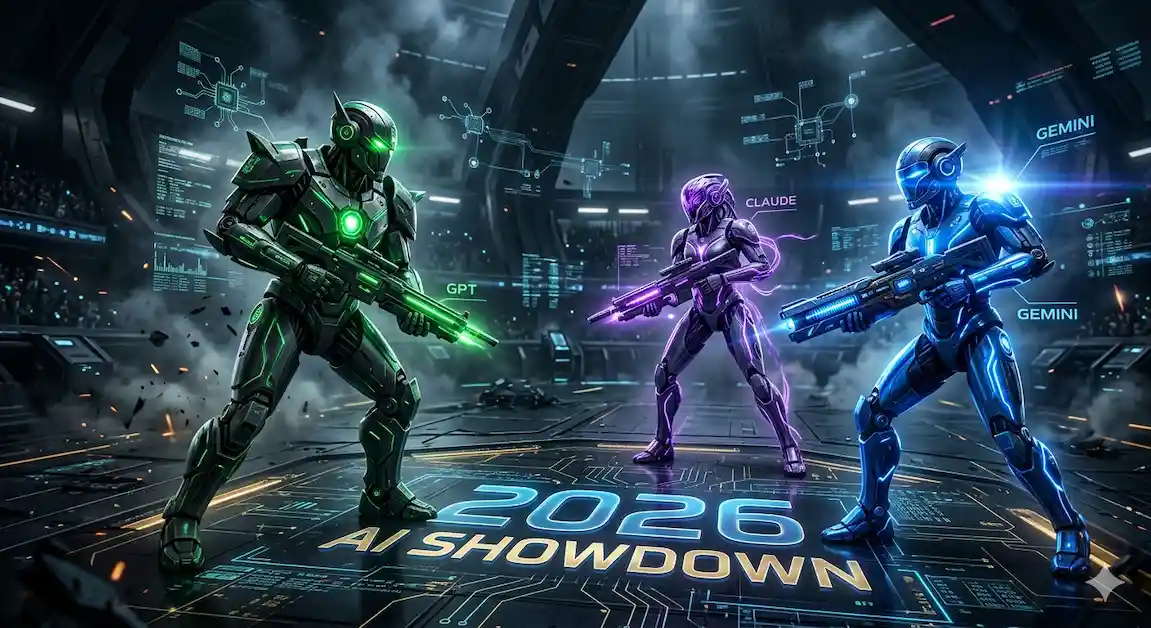
Full benchmark comparison: GPT-5.5 vs Claude Opus 4.8 vs Gemini 3.5 Flash — pricing, speed, coding scores, and which AI model to use for each task in 2026 and the leading AI models—OpenAI’sGPT-5.5 vs Claude Opus 4.8 vs Gemini 3.5 Flash. This meta-analysis evaluates their performance on coding, reasoning, agentic workflows, long-context tasks, and price-to-performance ratio.
Table of Contents
Meet the Contenders — What’s New in Each Model GPT-5.5 vs Claude Opus 4.8 vs Gemini 3.5 Flash
Claude Opus 4.8 (Anthropic, May 28, 2026)
Anthropic’s most capable publicly available model. Built for agentic coding and long-horizon autonomous tasks. Key upgrades over Opus 4.7: a 4.9-point SWE-bench Pro improvement; 4× fewer unflagged code flaws; 17× fewer dishonest agentic summaries. Context: 1M tokens, up to 128K output. Includes “fast mode” (research preview) and an effort parameter to trade thoroughness for speed. Pricing: $5/M input, $25/M output.
GPT-5.5 — codename “Spud” (OpenAI, April 23, 2026)
OpenAI’s first fully retrained base model since GPT-4.5 — not an incremental update, a ground-up rebuild. Co-designed with NVIDIA’s GB200/GB300 NVL72 rack systems. Natively omnimodal: text, images, audio, and video flow through one unified architecture (previous GPT “multimodal” models stitched separate systems together). MRCR v2 long-context score doubled from 36.6% to 74.0% vs GPT-5.4. Pricing: $5/M input, $30/M output. Available in ChatGPT Plus/Pro/Business/Enterprise.
Gemini 3.5 Flash (Google, May 19, 2026)
Launched at Google I/O. Described as a “Flash-tier” (fast and cheap) model — yet it outperforms last year’s premium Gemini 3.1 Pro on coding and agentic benchmarks. Default model in the Gemini app and Google Search AI Mode, reaching billions of users. Pricing: $1.50/M input, $9/M output — roughly 70% cheaper than Opus 4.8. Speed: 182–278 tokens/second (4× faster than rival frontier models). Note: 10× price increase from the previous Flash tier ($0.15 → $1.50/M input).
Section image slot — see Image Prompts section below.
Benchmark Breakdown — Who Wins What
Open with a caveat: “All benchmark scores below are from official vendor publications and independent testing by Artificial Analysis, as of June 2026. Treat them as a starting point — your own workload is the only test that truly matters.”
Agentic coding (SWE-bench Pro)
- Claude Opus 4.8: 69.2% ← winner
- GPT-5.5: 58.6%
- Gemini 3.5 Flash: 55.1% The gap is not subtle. Opus 4.8’s 10.6-point lead over GPT-5.5 translates to real-world success on multi-file refactoring, bug location, and codebase migration tasks.
Terminal and CLI automation (Terminal-Bench 2.1)
- GPT-5.5: 78.2% ← winner
- Gemini 3.5 Flash: 76.2%
- Claude Opus 4.8: 74.6% This is the one row Anthropic didn’t highlight at launch. GPT-5.5 wins shell and CLI automation — the most practical category for unattended agent workloads.
Tool orchestration (MCP Atlas)
- Gemini 3.5 Flash: 83.6% ← winner
- Claude Opus 4.8: 82.2%
- GPT-5.5: not reported A Flash-tier model beating Anthropic’s newest flagship on MCP Atlas is the benchmark result that breaks the expected tier hierarchy.
Knowledge work (GDPval-AA Elo)
- Claude Opus 4.8: 1,890 Elo ← winner
- GPT-5.5: 1,769
- Gemini 3.5 Flash: 1,656 Opus 4.8’s 121-point Elo lead over GPT-5.5 translates to consistently better performance on analysis, legal reasoning, and knowledge-heavy tasks.
Multimodal and visual (CharXiv)
- Gemini 3.5 Flash: 84.2% ← winner (only model scored here) For image, video, audio, and document understanding at scale, Flash leads. Opus 4.8 handles text and image only; GPT-5.5 handles all modalities but Flash’s throughput and cost make it the default for visual pipelines.
Long-context retrieval (MRCR v2)
- GPT-5.5: 74.0% ← winner Previous versions: 36.6% — GPT-5.5 effectively doubled its own score. For reading and reasoning across 800-page documents or giant codebases, GPT-5.5 is now the strongest option.
Include a clean markdown table here:
| Benchmark | Claude Opus 4.8 | GPT-5.5 | Gemini 3.5 Flash |
|---|---|---|---|
| Intelligence Index | 61.4 (#1) | 60.0 (#2) | 55.3 (#9) |
| SWE-bench Pro | 69.2% | 58.6% | 55.1% |
| Terminal-Bench 2.1 | 74.6% | 78.2% | 76.2% |
| MCP Atlas | 82.2% | N/A | 83.6% |
| GDPval-AA Elo | 1,890 | 1,769 | 1,656 |
| CharXiv (multimodal) | N/A | N/A | 84.2% |
| Speed (tok/s) | ~67 | ~80–100 | 182–278 |
| Output price / 1M | $25 | $30 | $9 |
Caption: “Sources: Artificial Analysis, Anthropic launch documentation, OpenAI System Card — June 2026. N/A = not benchmarked by vendor.”
Pricing and Real-World Cost — The Number That Actually Matters
Move beyond per-token pricing. Show daily cost at a realistic workload: 10M tokens/day, 70% input / 30% output.
Using the formula: cost = tokens × (0.7 × input + 0.3 × output) ÷ 1,000,000:
- Claude Opus 4.8: $110/day
- GPT-5.5: $125/day (most expensive)
- Gemini 3.5 Flash: $37.50/day (70% cheaper than Opus 4.8)
Value metric — intelligence index points per output dollar:
- Gemini 3.5 Flash: 6.1 points per dollar
- Claude Opus 4.8: 2.5 points per dollar
Note on GPT-5.5’s cost claim: OpenAI says ~40% token efficiency gain in Codex workflows effectively reduces the price increase to ~20% for agentic tasks. Standard API workloads get no discount.
Note on Gemini Flash pricing controversy: the previous Flash tier cost $0.15/M input. The new Flash is $1.50/M — a 10× increase, even as Google markets it as the budget option. A 90% cache discount is available for repeated prompts.
Who Should Use Which Model? (The Routing Guide)
This is the most shareable section. Frame it as a decision framework, not a winner announcement.
Use Claude Opus 4.8 if you…
- Do complex, multi-file coding or code review
- Run autonomous agents that make irreversible decisions (finance, legal, medical)
- Need maximum honesty — Opus 4.8 is 4× less likely to let a flaw go unflagged vs Opus 4.7
- Work in knowledge-intensive fields where silent errors are costly
- Use Claude Code with Dynamic Workflows and parallel subagents
Ideal for: engineers, analysts, researchers, legal professionals, content writers doing long-form research
Use GPT-5.5 if you…
- Run terminal-heavy workflows, CLI automation, or DevOps pipelines
- Need omnimodal input — text, image, audio, and video in one system
- Want the broadest third-party integration ecosystem (most platforms integrate GPT first)
- Work on long-context documents (contracts, codebases, reports) — MRCR v2 score doubled
- Build in OpenAI’s native ecosystem (ChatGPT, Codex, upcoming super app)
Ideal for: developers building cross-format pipelines, power users on ChatGPT Pro, DevOps teams
Use Gemini 3.5 Flash if you…
- Run high-volume, cost-sensitive tasks (classification, summarization, drafts)
- Build latency-sensitive customer-facing apps (4× faster than rivals)
- Work with multimodal content at scale — video, audio, PDFs, images
- Are already in the Google Workspace / Google Cloud ecosystem
- Need strong MCP tool orchestration at low cost (83.6% MCP Atlas)
Important caveat: Gemini 3.5 Flash has a reported 61% hallucination rate in independent testing. Do not use it for production code or high-stakes decisions without human review.
Ideal for: content creators, marketers, app builders, Google Cloud users, anyone processing large volumes of routine tasks
The expert move — use all three
Most sophisticated teams in 2026 don’t pick one model. They route:
- Opus 4.8 for complex coding and reliability-critical agents
- GPT-5.5 for terminal and long-horizon agentic tasks
- Gemini 3.5 Flash for volume, speed, and multimodal pipelines
This routing approach cuts total AI spend 40–60% vs running everything on a single premium model.
CTA: “Want to see the best AI tools that integrate all three models? See our guide: [Best AI Productivity Tools 2026] →”
Section image slot — see Image Prompts section below.
Limitations — What the Benchmark Tables Don’t Tell You
Claude Opus 4.8
Trails GPT-5.5 on terminal coding by ~3.6%. Most expensive per-output token ($25/M). Verbose responses fill context windows faster, raising costs on long agentic runs. Handles text and image only — no audio or video.
GPT-5.5
Most expensive output price ($30/M output). API pricing doubled from GPT-5.4 ($15 → $30). Time to first token can feel slow in real-time interactive apps (~3 seconds). Codex context window capped at 400K (not full 1M).
Gemini 3.5 Flash
61% hallucination rate in independent evaluations — the biggest risk of the three. Not suitable for production code without human review. Time to first token: 18.88 seconds (surprisingly high for a “fast” model). 10× price hike from the previous Flash tier frustrated developers who built pipelines on the old pricing.
Frequently Asked Questions
Q1: Which is the best AI model in 2026?
There is no single best model — each leads a different category. Claude Opus 4.8 leads on intelligence and coding. GPT-5.5 leads on terminal automation and long-context retrieval. Gemini 3.5 Flash leads on speed, cost, and multimodal tasks.
Q2: Is GPT-5.5 better than Claude Opus 4.8?
It depends on the task. GPT-5.5 wins on Terminal-Bench 2.1 (78.2% vs 74.6%) and long-context retrieval (MRCR v2 74% — doubled from GPT-5.4). Claude Opus 4.8 wins on SWE-bench Pro coding (69.2% vs 58.6%), knowledge work (GDPval Elo 1,890 vs 1,769), and autonomous agent reliability.
Q3: Is Gemini 3.5 Flash worth it?
Yes — for the right workloads. At $1.50/$9 per million tokens and 4× the speed of rivals, it’s the best value model for high-volume pipelines, multimodal tasks, and latency-sensitive apps. However, its 61% hallucination rate makes it unsuitable for production code or high-stakes outputs without human review.
Q4: How much does GPT-5.5 cost?
GPT-5.5 costs $5 per million input tokens and $30 per million output tokens via the API — double GPT-5.4’s output price. OpenAI claims ~40% token efficiency gains in Codex tasks reduce the effective cost increase to roughly 20% for agentic workloads.
Q5: Can I use all three AI models together? Yes — and this is what expert teams do. They route complex coding tasks to Claude Opus 4.8, terminal and long-context work to GPT-5.5, and high-volume or multimodal tasks to Gemini 3.5 Flash. This routing strategy typically reduces total AI spend by 40–60% versus running everything on one premium model.
Q6: What is GPT-5.5’s codename “Spud”?
“Spud” is the internal development codename OpenAI used for GPT-5.5. It reflects OpenAI’s tradition of giving models informal internal names during development. GPT-5.5 is described as self-deprecatingly named, though the model itself is far from humble — it’s the first fully retrained OpenAI base model since GPT-4.5 and co-designed with NVIDIA’s GB200/GB300 hardware.
Conclusion
Reinforce the routing verdict. No model sweeps the board — Opus 4.8 for intelligence, GPT-5.5 for terminal work, Gemini 3.5 Flash for volume and multimodal. The real winner is the reader who uses all three strategically. Close with CTA to blogpost.site’s AI tools hub and newsletter.


One thought on “GPT-5.5 vs Claude Opus 4.8 vs Gemini 3.5 Flash: The Brutal 2026 AI Model Showdown (Full Comparison)”