


Discover the best AI tools for non-tech doctors that cut paperwork, save hours each week, and boost patient care — no coding or IT skills required.
Table of Contents
AI Tools for Non-Tech Doctors: Complete 2026 Guide
If you became a doctor to help patients, not to wrestle with software, you are not alone. Most physicians did not sign up for spreadsheets, clunky electronic health record (EHR) screens, or hours of after-hours charting. Yet that is exactly where many doctors end up every single evening.
Here is the good news: AI tools for non-tech doctors have quietly become some of the most user-friendly software on the market. You do not need to write a line of code, understand machine learning, or hire an IT consultant to benefit from them. Many of these tools work with a single click, a voice command, or a short setup call.
In this guide, we will walk through what AI tools for non-tech doctors actually are, why so many physicians are adopting them in 2026, the best categories to know about, how to choose one without getting overwhelmed, and the mistakes to avoid along the way. By the end, you will have a clear, practical starting point — no technical background required.
What Are AI Tools for Non-Tech Doctors?

AI tools for non-tech doctors are software platforms built specifically for clinicians who do not have a technical or programming background. Instead of requiring setup scripts or developer knowledge, these tools are designed around simple dashboards, voice input, and one-time onboarding.
The core idea behind AI tools for non-tech doctors is accessibility. A general AI platform built for software engineers might require API keys and configuration files. A tool built for doctors, on the other hand, is usually plug-and-play: log in, connect it to your existing systems, and start using it the same day.
Most AI tools for non-tech doctors fall into a few broad categories — documentation, scheduling, patient communication, diagnostic support, billing, and research. We will cover each of these in detail below.
Why Non-Tech Doctors Are Turning to AI Tools in 2026

Physician burnout has been a growing concern for years, and administrative burden is consistently cited as one of the biggest contributors. Doctors regularly report spending evenings and weekends finishing notes that piled up during the day. This is precisely the gap that AI tools for non-tech doctors are designed to close.
A few practical reasons doctors are adopting these tools right now:
- Time pressure. Shorter appointment slots and growing patient loads leave little room for manual paperwork.
- Staffing shortages. Many clinics are short-staffed, so administrative tasks fall back on the physician.
- Patient expectations. Patients now expect fast follow-ups, digital communication, and quick turnaround on results.
- Simplicity of modern tools. Unlike early healthcare software, today’s AI tools for non-tech doctors are built with the same ease-of-use standards as consumer apps.
The shift is not about replacing clinical judgment. It is about removing repetitive, low-value tasks so doctors can spend more time actually practicing medicine.
Best Categories of AI Tools for Non-Tech Doctors
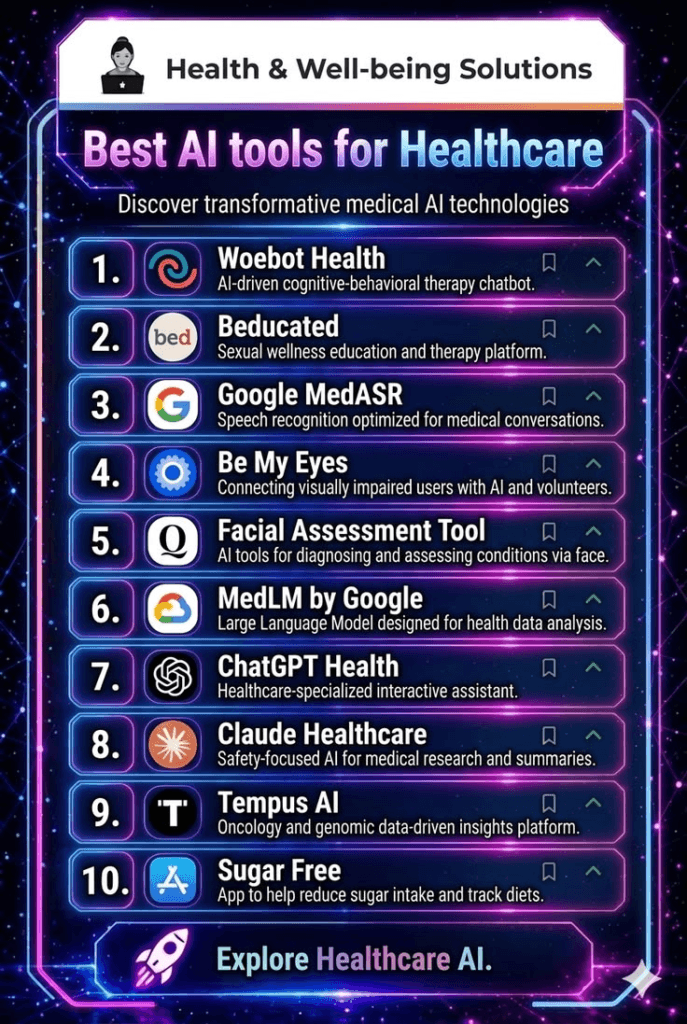
Not every AI tool fits every practice. Below are the categories that tend to deliver the fastest, most noticeable results for doctors without a technical background.
AI Tools for Non-Tech Doctors: Clinical Documentation
Ambient AI scribes are one of the most popular entry points into AI tools for non-tech doctors. These tools listen to the natural conversation between a doctor and patient, then automatically generate a structured clinical note. Well-known names in this space include Nuance DAX, Abridge, Suki, and DeepScribe.
For a non-technical doctor, the appeal is simple: there is nothing to configure beyond opening an app or wearing a small microphone. The note appears in draft form, ready for a quick review and signature, which can cut documentation time dramatically compared to manual typing.
AI Scheduling and Front-Desk Automation Tools
Front-desk AI tools handle appointment booking, reminders, rescheduling, and basic patient questions through chat or phone. For non-tech doctors, this category matters because it reduces no-shows and frees front-desk staff from repetitive phone calls, without requiring the doctor to touch the software at all.
AI Tools for Patient Communication and Follow-Up
These tools automatically send post-visit instructions, medication reminders, and check-in messages. Instead of relying on staff to remember every follow-up call, the system handles routine communication, flagging only the cases that need a human response.
AI-Assisted Diagnostic Support Tools
This category includes AI systems that flag abnormal lab values, highlight patterns in imaging, or suggest possible differential diagnoses based on patient history. It is important to note that these are decision-support tools, not replacements for clinical judgment. A non-tech doctor can use them as a “second set of eyes” that surfaces information faster, while the final call always remains with the physician.
AI Tools for Billing and Insurance Claims
Billing software powered by AI can automatically check codes, flag likely claim denials before submission, and suggest corrections. For non-tech doctors running smaller practices without a dedicated billing department, this category alone can meaningfully reduce revenue lost to rejected claims.
AI Tools for Continuing Education and Research
Several AI tools now summarize medical journal articles, condense long research papers into a few key takeaways, and help doctors keep up with new guidelines without spending hours reading. These tools are especially useful for non-tech doctors who want to stay current but have limited time to dig through academic databases.
How to Choose AI Tools for Non-Tech Doctors Without Getting Overwhelmed

With dozens of options on the market, choosing the right AI tools for non-tech doctors can feel like its own full-time job. A few practical filters can narrow the field quickly:
- Ease of setup. If a sales demo includes terms like “API,” “webhook,” or “custom integration,” it is probably not built for a non-technical user.
- EHR compatibility. Confirm the tool works with your existing electronic health record system before signing anything.
- Security and compliance. Any AI tool handling patient data must be HIPAA-compliant, with a signed Business Associate Agreement (BAA).
- Live support. Look for vendors offering phone or chat support, not just email tickets, especially in the first few weeks.
- Free trial or pilot period. A reputable vendor will let you test the tool with real (or sample) patient encounters before committing.
Getting Started: A Step-by-Step Plan for Non-Tech Doctors

You do not need to overhaul your entire practice at once. A simple, low-risk approach works best for most non-tech doctors:
Step 1: Identify your biggest pain point. Is it charting after hours? Missed follow-ups? Billing denials? Start there.
Step 2: Pick one tool, not five. Trying to implement multiple AI tools for non-tech doctors at the same time often leads to confusion and abandoned subscriptions.
Step 3: Request a live demo. A 20-30 minute walkthrough will tell you more than any marketing page.
Step 4: Involve your staff early. Even the simplest AI tools work better when front-desk and clinical staff understand the basics before go-live day.
Step 5: Review results after 30 days. Track time saved, error rates, or patient feedback, then decide whether to expand, adjust, or switch tools.
Common Mistakes Non-Tech Doctors Make When Adopting AI Tools

Even simple AI tools for non-tech doctors can fail to deliver results if adopted the wrong way. Watch out for these common missteps:
- Trying to automate everything at once. Start narrow, then expand once the team is comfortable.
- Skipping staff training. A tool is only as effective as the people using it day to day.
- Ignoring the compliance review. Always confirm data handling and storage policies before entering patient information.
- Expecting instant perfection. Most AI tools improve in accuracy as they learn your speech patterns, templates, or workflow — give them a few weeks.
- Not reviewing AI-generated output. AI-drafted notes, billing codes, or diagnostic flags should always be checked by a clinician before being finalized. AI tools for non-tech doctors are designed to assist, not to make unsupervised clinical decisions.
(External link suggestion: link to federal guidance on health data privacy, e.g., HHS.gov at https://www.hhs.gov/hipaa/index.html)
Frequently Asked Questions About AI Tools for Non-Tech Doctors
Do I need technical skills to use AI tools as a doctor?
No. Most AI tools for non-tech doctors are built with simple, voice- or click-based interfaces specifically so that physicians without an IT background can use them without training in coding or software development.
Are AI tools for non-tech doctors safe and HIPAA-compliant?
Reputable AI tools for non-tech doctors are built to be HIPAA-compliant and will offer a signed Business Associate Agreement (BAA). Always confirm this in writing before entering any patient information into a new platform.
How much do AI tools for non-tech doctors typically cost?
Pricing varies widely by category, ranging from roughly $50 to $500+ per provider, per month for documentation and billing tools. Many vendors offer tiered pricing or free trials, so it’s worth comparing a few options before committing.
Can AI tools replace a doctor’s clinical judgment?
No. AI tools for non-tech doctors are designed to support tasks like documentation, scheduling, and flagging information faster — final clinical decisions should always remain with the physician.
What’s the easiest AI tool for a non-tech doctor to start with?
Ambient AI scribes for clinical documentation are generally considered the easiest entry point, since they require minimal setup and deliver noticeable time savings within the first few uses.
Final Thoughts: AI Tools for Non-Tech Doctors Are Easier Than You Think
The biggest myth around AI tools for non-tech doctors is that they require a technical learning curve. In reality, most are built to be picked up in a single afternoon, with the heavy lifting handled behind the scenes by the vendor.
Whether your biggest frustration is after-hours charting, missed follow-ups, or billing denials, there is very likely an AI tool built specifically to solve that problem — without asking you to become a software expert first.
Ready to take the first step? Pick the one task that drains the most time from your week, look for an AI tool built for that exact problem, and request a live demo this month. Small, focused changes like this are how most non-tech doctors successfully bring AI tools for non-tech doctors into their practice — one workflow at a time.


На этом портале можно почерпнуть немало полезной материалов.
Здесь размещены обзоры и советы для любого запрос.
Посетитель сможете изучить как базовую базу, также углублённые кейсы.
Данный ресурс может оказаться полезным экспертам в различной работе.
https://labdiz.ru/full/256-kak-otlichit-podlinnye-krossovki-dolceandgabbana-ot-poddelki.htm
Более того здесь часто появляются новые обновления.
Советуем подробно ознакомиться с представленную здесь базу.
Таким образом, данный ресурс служит незаменимым хранилищем сведений.
Здоровое отношение к азарту — это совокупность правил, ориентированных на сохранение психологического и финансового равновесия игрока.
Ключевая идея состоит в том, что процесс должна восприниматься только как развлечение, а не как способ обогащения.
Игроку рекомендуется заранее устанавливать лимиты по длительности и деньгам и неукоснительно их соблюдать.
https://eurasia-log.ru/blog/2026-06-29-regulirovanie-i-litsenzirovanie-onlayn-kazino-v-rossii/
Важно уметь распознавать ранние признаки проблемного поведения, такие как погоня за проигрышем и игнорирование повседневными делами.
Платформы обязаны предлагать функции ограничения: паузы, ограничения пополнений и блокировку аккаунта.
Соблюдение этих правил позволяет сохранить игру в безопасных рамках, не нанося ущерба себе и окружающим.
Здоровое отношение к азарту — это комплекс правил, направленных на защиту психологического и материального благополучия игрока.
Ключевая мысль заключается в том, что процесс должна рассматриваться только как досуг, а не как способ заработка.
Игроку следует предварительно определять ограничения по длительности и деньгам и строго их придерживаться.
https://liveforsport.ru/full-text/1519-blokcheyn-i-onlayn-azartnye-igry-transformatsiya-gorizontov.html
Важно уметь замечать первые признаки проблемного поведения, такие как погоня за проигрышем и пренебрежение обязанностями.
Платформы должны предлагать инструменты самоконтроля: паузы, ограничения пополнений и блокировку аккаунта.
Соблюдение этих рекомендаций даёт возможность удержать игру в комфортных границах, не нанося вреда себе и окружающим.
Здоровое отношение к азарту — это комплекс принципов, направленных на защиту психологического и материального благополучия участника.
Базовая идея заключается в том, что игра должна восприниматься только как развлечение, а не как способ заработка.
Игроку рекомендуется предварительно устанавливать лимиты по длительности и бюджету и неукоснительно их соблюдать.
https://relax-spb.ru/read-info/2825-v-konstantinovke-ukrainskie-voyska-okazyvayutsya-v-bezvykhodnom-polozhenii.html
Необходимо уметь замечать первые симптомы проблемного поведения, такие как погоня за проигрышем и пренебрежение повседневными делами.
Операторы должны предлагать инструменты самоконтроля: паузы, ограничения пополнений и блокировку аккаунта.
Соблюдение данных правил позволяет удержать игру в безопасных рамках, не нанося вреда себе и окружающим.
На представленном ресурсе есть возможность обнаружить немало полезной сведений.
Тут собраны заметки и инструкции для любого случай.
Вы сможете получить и широкую информацию, также углублённые данные.
Представленный портал может оказаться полезным новичкам в своей практике.
https://protivbed.ru/full-article/sochetanie-barokko-i-sporta-estetika-krossovok-dolceandgabbana-993/
Также на сайте часто выкладываются интересные материалы.
Рекомендуем внимательно прочитать доступную здесь коллекцию.
В итоге, этот сайт представляет собой незаменимым источником сведений.
Разумное отношение к азарту — это принцип к казино, базирующийся на самоограничении и осознании последствий.
Она включает осознанное лимитирование времени и расходов на игру.
Каждый игрок должен предварительно устанавливать лимиты потерь и строго их придерживаться.
https://online-festival.ru/detail/3285-magiya-povsednevnogo-vystavka-martina-bedan-v-saint-laurent-montaigne.html
Mindful gaming is a set of practices that ensure gambling remains a form of entertainment rather than a source of stress or loss.
Key aspects include establishing personal limits on time and money spent, as well as recognising the indicators of harmful behaviour.
In essence, this approach encourages conscious choices and helps users to keep balance over their gaming habits.
https://liveforsport.ru/full-text/1503-rich-casino-vs-competitors-a-comparative-analysis.html
Осознанный гемблинг — это стратегия к азартным сессиям, базирующийся на самоограничении и осознании последствий.
Эта концепция предполагает добровольное лимитирование времени и денег на процесс.
Каждый игрок обязан предварительно определять лимиты ставок и неукоснительно их соблюдать.
https://joomlaprofi.ru/news/1061-matematika-i-veroyatnosti-v-igrovykh-slotakh-chto-dolzhen-znat-igrok/
Prudent betting is a collection of practices that ensure gambling remains a form of entertainment rather than a source of stress or loss.
Key aspects include setting personal limits on time and money spent, as well as being aware of the signs of harmful behaviour.
Ultimately, this approach encourages informed choices and supports players to maintain balance over their gaming habits.
https://online-festival.ru/detail/3043-tri-puti-vedushchie-evropu-k-konfliktu-s-rossiey.html
Ответственная игра — это выбор, при котором азарт служат формой досуга, а не стремлением заработать.
Она строится на управлении длительностью и расходами, а ещё на понимании личных пределов.
https://graph.org/RandX-kogda-hochetsya-ostrogo-a-ne-predskazuemogo-06-30
Разумное отношение к азарту — это принцип к азартным сессиям, базирующийся на контроле и понимании рисков.
Она предполагает добровольное ограничение времени и бюджета на процесс.
Каждый игрок обязан предварительно определять лимиты потерь и строго их соблюдать.
https://r5.balmain1.ru/X9FsQsF0YaeK/
Разумное отношение к азарту — это стратегия к азартным сессиям, базирующийся на контроле и осознании последствий.
Эта концепция включает осознанное ограничение продолжительности и бюджета на процесс.
Каждый участник обязан заранее устанавливать лимиты ставок и строго их придерживаться.
https://history.superlooks.ru/jjI3qeqDrhIt/
Ответственная игра — это подход к игровым развлечениям, базирующийся на самоограничении и осознании последствий.
Она включает осознанное ограничение времени и расходов на процесс.
Любой участник обязан заранее определять пределы ставок и строго их придерживаться.
https://bookmarks.balmain1.ru/wMzVytuNCWvq/
הפורטל הזה מעניק מגוון רחב של תכנים המיועדים לקהל הישראלי.
בפלטפורמה תוכלו להכיר תוכן ייחודיים בתחום למבוגרים באיכות גבוהה.
האתר נותנת אפשרות פשוטה לשירותים אלה באמצעות שמירה על אנונימיות הגולש.
https://hasfaniyot.net/
Осознанный гемблинг — это регламент, предназначенный на сохранение баланса по отношению к собственными действиями и снижение негативных последствий.
http://www.gorodnabire.ru/publikatsii/krossovki-balenciaga-triple-s-teper-proizvodyatsya-v-kitae
Осознанный подход к гемблингу — это выбор, при котором азарт являются формой досуга, а не средством поправить финансовое положение.
Такой подход базируется на управлении длительностью и бюджетом, а также на понимании личных границ.
https://online-festival.ru/detail/3417-ukhod-za-krossovkami-dolce-and-gabbana-kak-sokhranit-vneshniy-vid-i-prodlit-srok-sluzhby.html
Игровые автоматы — это самые известные игры в гемблинг-индустрии.
https://like.hypebeasts.ru/eD0xEaWAmGoC/
На этом сайте можно отыскать массу ценной материалов.
https://relax-spb.ru/read-info/3255-hailey-jean-novaya-kapsulnaya-kollektsiya-denima-ot-kheyli-biber-i-gap.html
На этом ресурсе есть возможность найти много ценной информации.
https://pilot-club.ru/info/2026-07-17-istoriya-razvitiya-krossovok-ot-pervykh-modeley-do-sovremennykh-tekhnologiy/
An unbranded drug is a formulation that is manufactured to be equivalent a innovator medicine in potency, quality, and performance.
It contains the exact active substance as the original drug, yet may differ in inactive ingredients and price.
To be approved, a generic must establish therapeutic equivalence to the original product, ensuring that it is just as safe and efficacious.
lady era legit
На данном сайте есть возможность отыскать много нужной материалов.
https://1-mk.ru/detail/501-dukhovshchina-gotovit-k-otkrytiyu-novuyu-ploshchadku-dlya-sdachi-norm-gto/
На представленном портале есть возможность отыскать массу практичной знаний.
https://hub.docker.com/u/kenigauto39
Məsul oyun — o deməkdir oyunçunun qərarlarını idarə etməsi və oyunun əyləncə forması olaraq saxlanılması üçün metodlar sistemidir.
O vaxt və pul xərclərinə limitlər təyin etməyi, həmçinin təhlükəli davranışlarını dərk etməyi tələb edir.
Nəticə olaraq, bu prinsiplər oyunçulara oyun üzərində nəzarəti qorumağa yardım edir və mümkün fəsadların minimuma endirməyə xidmət edir.
https://riobetcasino-0k92m.top/
На представленном портале удастся обнаружить массу нужной информации.
https://tltrock.ru/material/2026-07-24-intervyu-s-kreativnym-direktorom-premiata-o-budushchikh-napravleniyakh-v-mode-obuvi.html
Здоровый подход к азарту — это регламент, направленный на обеспечение контроля в отношении своими решениями и исключение рисков.
https://relax-spb.ru/read-info/1145-kak-budto-vorota-v-inoy-mir-plyusy-i-minusy-zhizni-ryadom-s-zheleznodorozhnym-vokzalom-v-ekaterinburge.html
На представленном ресурсе есть возможность отыскать немало полезной знаний.
https://mskfirst.ru/msk/2026-07-25-kak-raspoznat-poddelku-sumki-jimmy-choo-i-zashchitit-sebya-ot-moshennikov
Interactive play bring enthusiasts an excellent way to link and play with peers across the globe.
https://uipnz.ru/article/1570.html
Interactive titles supply players the amazing way to unite and discover with gamers worldwide.
http://www.casagrandelsiurana.com/2026/08/10/luchshie-ofitsialnye-kluby-s-obzorami-i-otzyvami-randx/